
Epoxy Floor Installation: What to Expect
Each step of an epoxy installation leans on the one before it. What the inspection finds sets the prep plan, the prep decides how well the coating holds, and the handling of the cure affects how the floor behaves in service.

The Short Answer
Installation unfolds in five stages: concrete inspection, surface grinding and cleaning, repair of visible damage, layered coating application and the cure. Before anything else happens, your installer looks over your slab in person and lays out a plan specific to it.
What Happens During Professional Epoxy Floor Installation?
The five stages follow a set order, with each one laying groundwork for the next.
01
Evaluate the Concrete
Your installer begins by examining the slab up close. Moisture readings, a search for any old sealer or coating, and a close surface review add up to a clear picture, which informs both the coating recommendation and how much prep the job requires.
02
Prepare the Surface
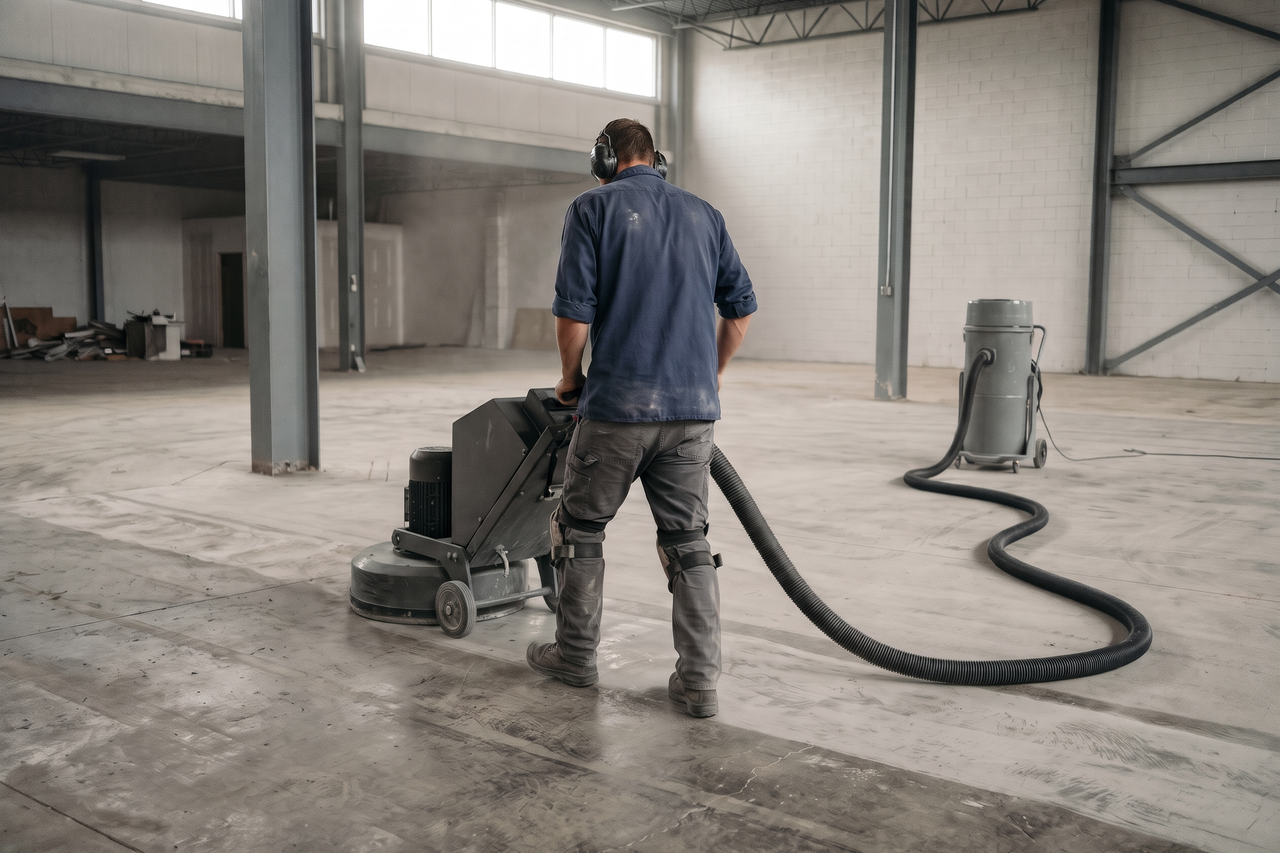
For epoxy to hold, the concrete must be opened mechanically so there is texture to grab. Shot blasting or diamond grinding removes the dense top skin and leaves that profile behind. How hard this step is depends on the slab’s past, any existing coatings and whatever has accumulated on it.
03
Repair Cracks and Defects
With the slab bare, the focus moves to cracks, spalls and other damage. Fixing them before coating keeps every flaw in view, so each one can be judged and handled according to its own condition.
04
Apply the Coating System
Each layer follows the manufacturer’s order: primer, then base coat, then an optional decorative broadcast, then topcoat. A layer must reach its proper set condition before the next one goes on.
05
Allow the Floor to Cure
After the topcoat goes down, the floor earns its uses one at a time: foot traffic first, then vehicles, with full chemical resistance coming last. Your installer covers each milestone with you before the project begins.
What Makes a Professional Installation Different?
Slabs that look like twins can prove to be strangers under testing. One may hide high moisture, old residue and moving cracks; the one beside it may be dry, clean and sound. A professional evaluation finds those differences instead of handling all concrete the same way.
Coatings that fail early usually fail for reasons someone can trace. Preparation is often part of the problem; moisture, product choice and installation conditions belong on that list too. Handling each well provides a better foundation for long-term performance.
Whenever you’re ready to discuss your concrete, tell us about your floor to request a customized quote.
Why Concrete Preparation Matters
Our deeper dive into readying concrete for coating covers grinding methods, crack repair and moisture testing, with a practical view of how each step is performed.
Epoxy’s hold on concrete is a mechanical one. Grinding opens the pores; the coating flows into that roughness and locks on. Sealed, painted or polished-smooth concrete gives it almost nothing to grab, which puts adhesion on an unprepared slab at a disadvantage from the start.
A floor’s history sets how much prep it needs. New, never-sealed concrete is nothing like a slab carrying old paint, mastic or several sealer coats. Your installer decides the prep scope from what the surface shows, rather than applying one standard to every job.
Repairing Cracks and Surface Damage
Repairs happen while the concrete is completely uncovered. Stripping old coatings and profiling the slab exposes how far cracks and weak areas really go, so each one gets fixed while it is still easy to reach, before primer covers it.
No two cracks are treated alike. A shallow crack that isn’t moving gets a different fix than one that is spreading or has an edge sitting higher than its neighbor. Active movement may need a flexible filler or a more extensive fix, and your installer describes how each defect will be treated before work goes further.
Coating over a crack that was never treated simply hides the problem. The finish can start lifting at the edges, and a crack that stays active may eventually reappear through the new surface. Bare concrete is the moment to fix defects properly.
Applying the Epoxy Coating System
If you want durability, UV behavior and application compared directly, see this side-by-side of epoxy and polyaspartic.
Once prep is complete, the system goes down layer by layer. Primer soaks into the profiled surface and anchors the layers that follow. When the design includes decorative flake, it gets scattered into the base coat while it is still wet, so the chips seat themselves before the material sets.
The topcoat takes the daily abuse from shoes, tools, vehicles and cleaning chemicals. Its product, coat count and film thickness are picked for the space’s demands, so a commercial floor handling heavy equipment and frequent chemical contact gets a heavier build than a lightly trafficked residential garage. Temperature and humidity are watched the whole way through, because each affects how every coat builds and bonds.
How Long Does Epoxy Flooring Take to Cure?
Curious which factors move a project’s price? Our rundown of epoxy coating costs explains the roles of floor size, condition and system choice.
A new coating earns its uses gradually: people on foot first, then vehicles, then full chemical exposure. Asking more of the floor than its current stage allows can scuff or dent it in ways that are tough to repair.
Chemical resistance develops last, once the film has cross-linked through its whole thickness. Firm to the touch does not mean finished, since the surface hardens ahead of that process. When the floor can return to service depends on the system and the conditions, and your installer explains it before work begins, considering floor size, condition and prep.
Frequently Asked Questions
Q: What does a concrete inspection tell you before any work starts?
Everything in the project follows from the inspection. Moisture tests, notes on prior sealers or coatings, a survey of cracks and a reading of the current surface profile point to the right system and to the prep the slab needs. Skip that step and the recommendation is just a guess.
Q: What goes wrong when surface preparation falls short?
A coating only grips as well as the grind profile lets it. If the profile comes out shallow, slick or dirty with old residue, adhesion suffers before a single coat goes on. Where a coating has peeled early, preparation is often part of the problem, along with moisture, the product chosen and installation conditions.
Q: Will a new coating bond over an existing one?
Sometimes, depending on what’s already there. If the existing coating is tightly bonded, has no lifting and suits the new material, it might be workable after an on-site evaluation. Peeling or delaminating coatings usually have to be removed first. Your installer checks the current surface and walks you through the options.
Q: How do I find out when walking, driving and chemical exposure are safe on the new floor?
Before work starts, your installer explains each milestone: the point when walking is fine, the point when vehicles may return and the stage at which the coating reaches full chemical resistance. How that plays out depends on floor size, condition, prep scope and the system used.
Q: Does a crack appearing in the finished coating mean the coating failed?
Not necessarily. Cracks that appear through a finished coating usually trace back to movement in the concrete underneath, whether settling, shifting or swelling from moisture, and not to a problem with the coating product itself. An experienced flooring professional is able to look at the crack, explain what likely caused it and say whether repair makes sense.
Q: Can on-site temperature and humidity change the outcome?
Yes. Manufacturers list the temperature and humidity ranges their products need during application and cure, and working beyond those limits can weaken adhesion and cause uneven setting. Your installer checks the site’s conditions before beginning and monitors them as the work continues.
Ready to Upgrade Your Concrete Floor?
Serving Hopkinsville, KY and surrounding areas. Describe your concrete and how people use the space to request a customized quote.